
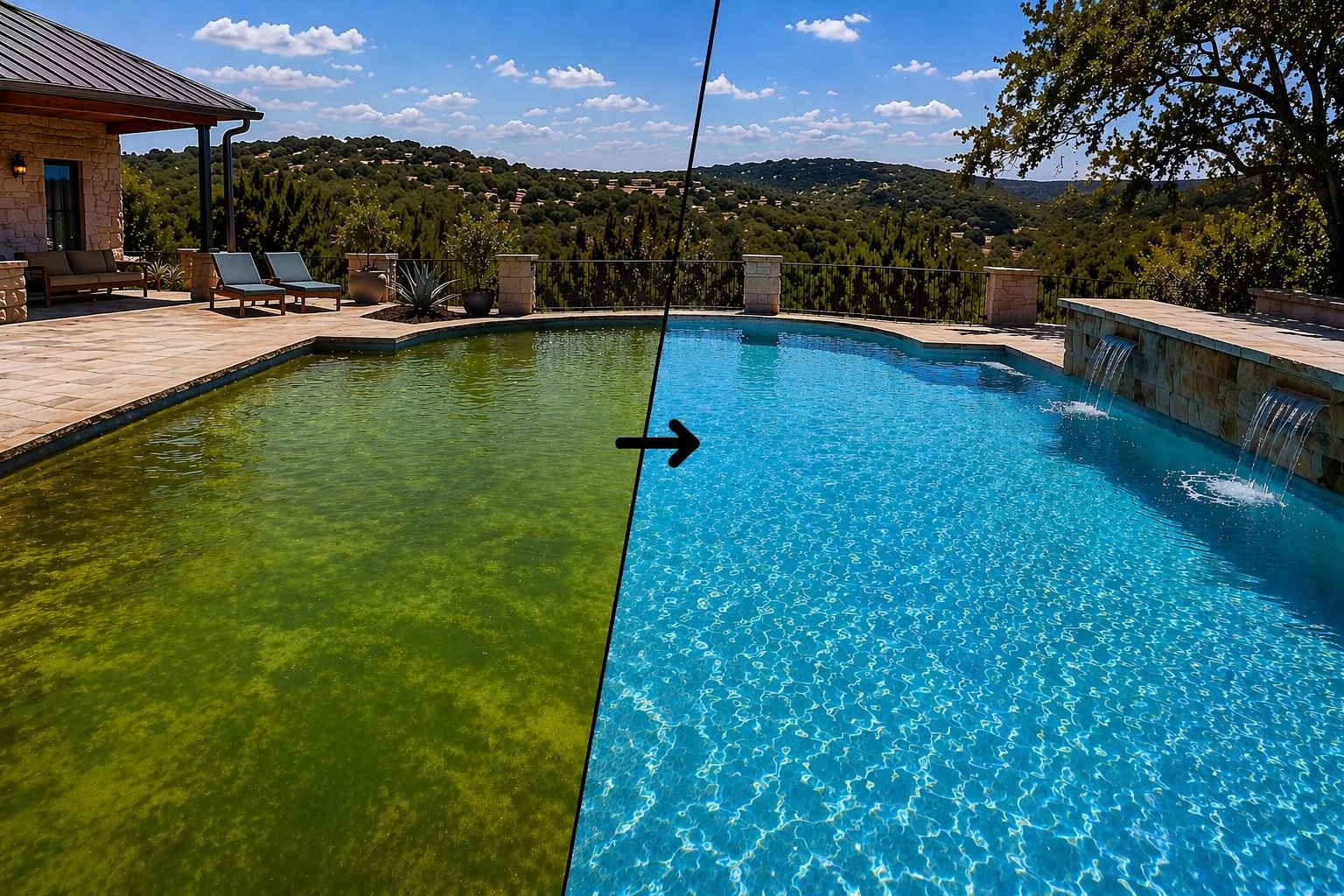
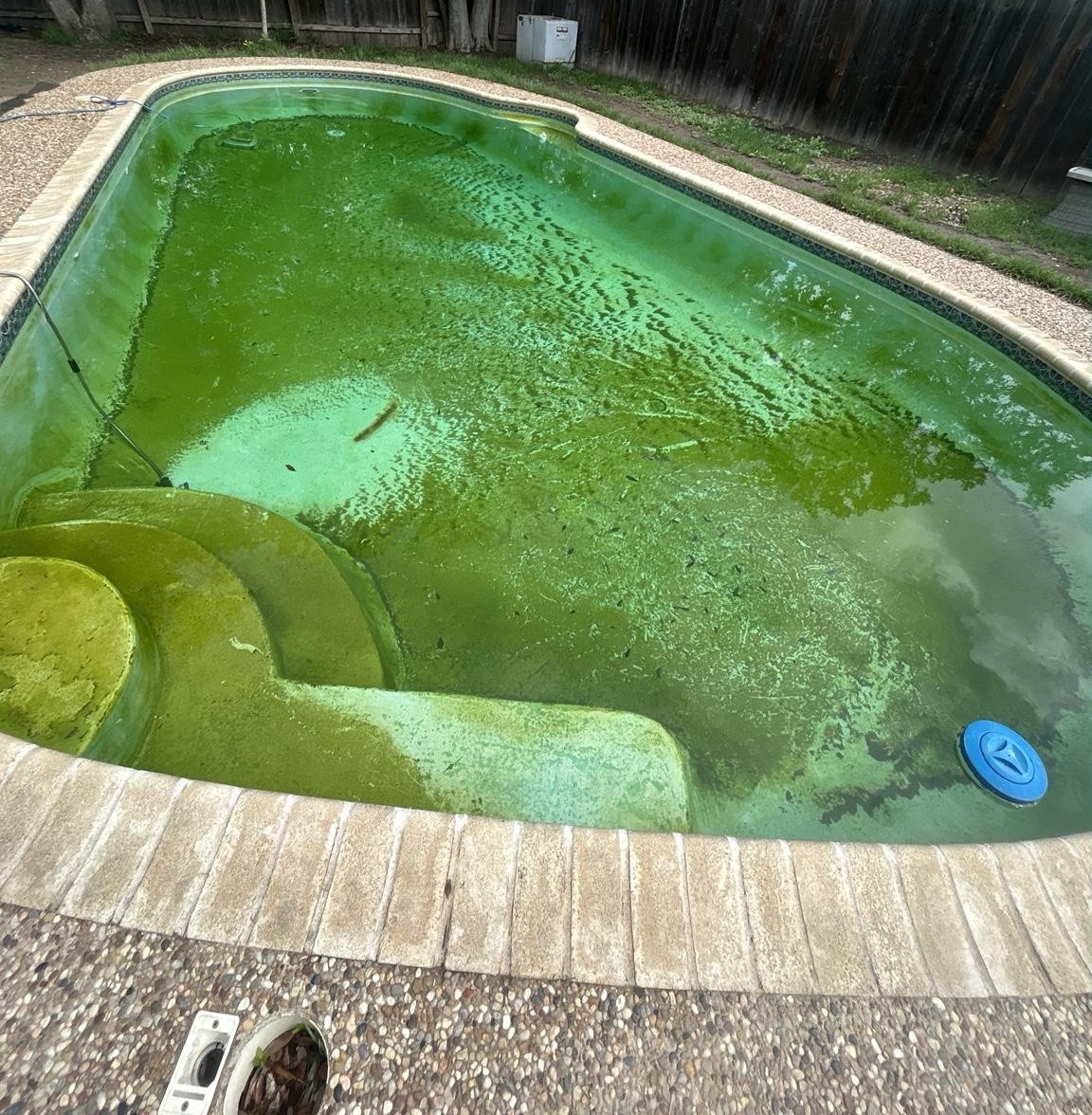
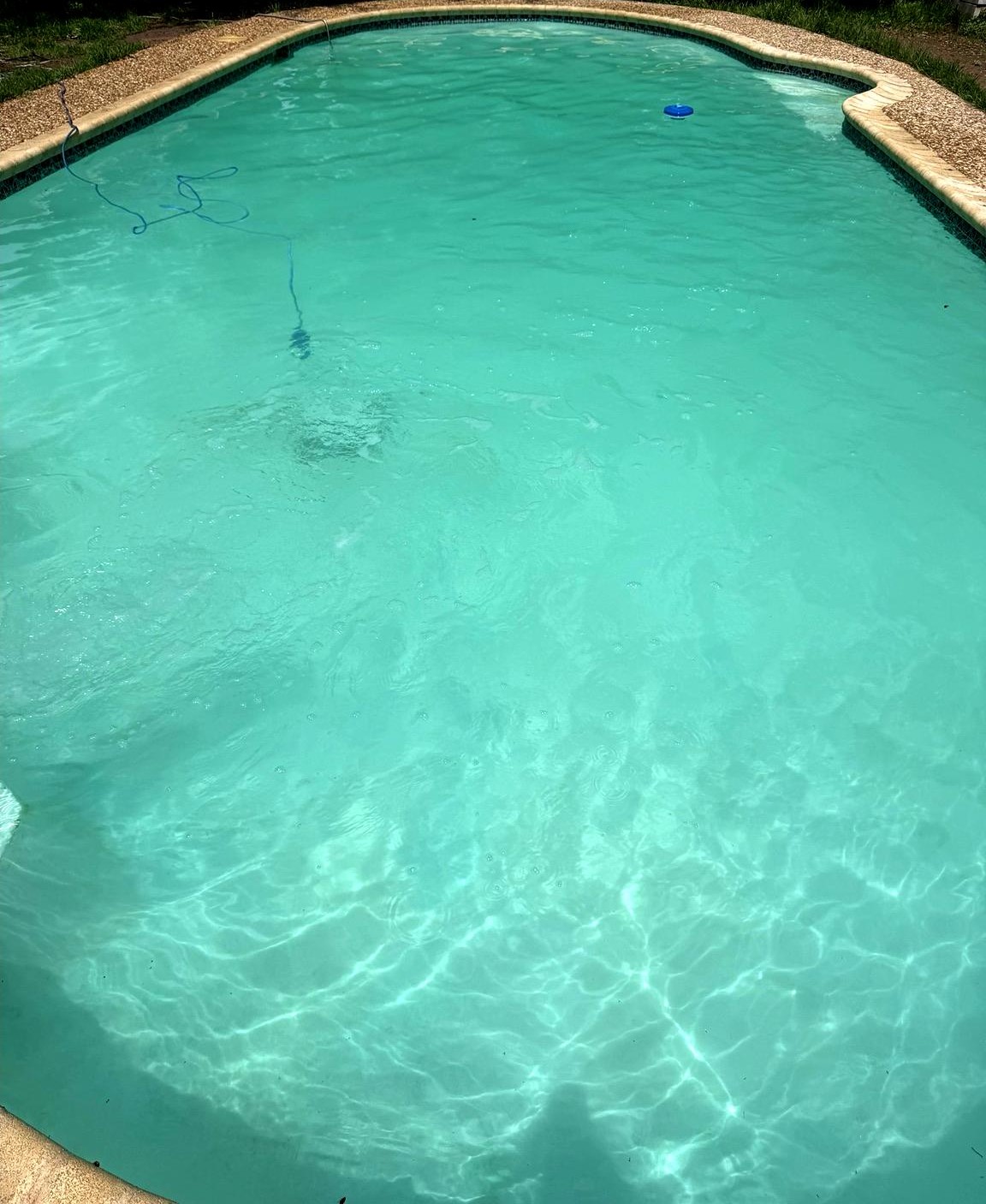
Saturday afternoon: eight kids in the pool, barbecue going, everything great. Sunday night: green pool. The homeowner had done everything right all season — weekly chlorine, pump running daily, regular skimming. It still happened. By the time they called us Sunday night, the water was fully green. We had it crystal clear by Sunday afternoon the next day. Here’s the full story of what went wrong, and the exact process we used to fix it.
The Pollen Season Trap
Most Austin pool owners think of pollen as a cosmetic problem — that yellow dust floating on the surface looks bad, but a quick skim and you’re done. That’s the trap.
Pollen isn’t just visual noise. It’s organic material. And when large amounts of it settle into your water — which happens fast during peak Central Texas spring bloom — it creates a chain reaction that can overwhelm your pool’s chemistry in less than 48 hours.
Why pollen turns your pool green (it’s not what you think)
- 🌿Pollen feeds algae. Pollen is organic material. When it settles into your water in large quantities, it becomes a food source for algae. The more pollen, the more fuel.
- 🌡️Spring water temps hit algae’s sweet spot. Once water temperatures climb into the mid-60s — which happens fast here in April — algae growth accelerates dramatically. Warm water + organic food = algae’s perfect conditions.
- ⚗️Your chlorine gets eaten faster than normal. All that organic load from pollen consumes your free chlorine at an accelerated rate. Your standard routine that worked fine all winter may not be enough during peak bloom weeks.
- ⏱️The window closes fast. Stack all three together and a pool that looked perfectly fine on Friday can be fully green by Sunday. Not because you did anything wrong — because the conditions were stacked against you.
What Happened to This Pool
The homeowner’s pool was well-maintained. Weekly chemical checks, pump running daily, regular skimming. But the week before they called us, Central Texas hit peak mountain cedar and oak pollen simultaneously — one of the heaviest bloom windows of the year.
Pollen settled into the water faster than the skimmer could remove it. The organic load spiked. Chlorine demand shot up. And by the time the homeowner noticed the water “looked a little off” Sunday morning and added extra chlorine — the standard response — it was already too late. The algae bloom was already in motion. By Sunday night: fully green.
Throwing chlorine at a green pool without balancing the water chemistry first is why some people spend a week trying to fix what should take one day. Chlorine works significantly better — and your equipment holds up better — when pH and alkalinity are in range first. Dumping shock into unbalanced water is inefficient at best. At worst, it’s hard on your equipment and still doesn’t fix the problem.
The 7-Step Pool Rescue Process
Here’s exactly what we did — in order. The sequence matters. Skip steps and you’re wasting product and time.
Test the water first — always
Before we do anything, we need to know what we’re working with. pH, total alkalinity, calcium hardness, cyanuric acid. You can’t start dumping product in without this baseline. It tells you what’s actually wrong and what the water needs.
Balance pH and alkalinity before shocking
This is the step most DIYers skip — and it’s why they spend a week on a one-day fix. Chlorine’s effectiveness drops dramatically when pH is high. We adjust pH to 7.2–7.6 and alkalinity to 80–120 ppm before adding any shock.
Shock with a high-dose chlorine treatment
Once the water is balanced, we apply a high-dose chlorine shock targeted at the algae bloom. With balanced water, this hits significantly harder. The goal is to overwhelm the algae and break the bloom.
Run continuous circulation — non-stop
The pump runs non-stop from this point forward. Circulation distributes the chemicals to every corner, hits dead spots where algae hides, and continuously pulls dead algae toward the filter.
Brush every surface
Dead algae clings to walls and floor. It doesn’t just float away on its own — you have to physically brush it off every surface so the filter can capture it. Walls, floor, steps, corners. All of it.
Filter and backwash — repeat as needed
As the filter loads up with dead algae and debris, it needs to be backwashed to restore flow. We monitor the pressure gauge and backwash whenever it climbs. Repeat until the water starts to clear.
Clarifier and final chemistry check
Once the water visually clears, we add a clarifier to pull together any remaining fine particles the filter might miss. Then a final full chemistry test to confirm everything is back in range before we leave.
“That’s the process. It’s not complicated, but it has to be done in the right order. If you skip the balancing step and go straight to shock, you’re wasting product and stressing your equipment.”
How to Prevent It During Pollen Season
Prevention is significantly easier than the rescue. Here’s what to do right now if you have a pool in Central Texas and pollen season is in full swing:
Test your water now. Don’t guess — you need to know your actual chlorine and pH levels before doing anything else. Weekly testing becomes bi-weekly during peak bloom.
Run your pump longer. During heavy pollen weeks, bump circulation up to 8–10 hours per day.
Skim daily. The sooner you remove pollen from the surface, the less organic load builds up in the water. A surface skimmer sock can also help catch fine pollen particles.
Check your filter. A dirty or clogged filter can’t do its job. Clean or backwash it before peak season and monitor it weekly during bloom.
If your water is already looking hazy or slightly green — don’t throw chlorine at it and hope. The sequence matters. Test first, balance second, then shock.
When to Call a Professional
You can absolutely follow the 7-step process above yourself. But there are situations where calling in a pro saves you significant time, money, and frustration: if the water is fully green (can’t see the bottom), if you’ve already tried shocking and it hasn’t worked after 48 hours, if your chemistry is severely out of range, or if you simply don’t have the time to run the pump, brush, and backwash repeatedly over a full day.
We rescued this particular pool in under 24 hours because we’ve done it dozens of times and know exactly what sequence works. A first-time green pool rescue DIY attempt often takes 3–5 days when steps are done out of order or skipped.
OutdoorJack offers pool cleaning and water chemistry services in Austin, Cedar Park, Round Rock, Lakeway, Georgetown, and surrounding communities. One visit, done right.
Pool already green? We can fix it.
We offer pool rescue and ongoing maintenance services across Central Texas. One visit, done in the right order, done right.
Book a Pool Assessment →Same-week availability during pollen season · No long-term contract required

